Is It Safe to Sleep With Your Cat? What Cat Owners Should Know
Is It Safe to Sleep With Your Cat?
At some point in the night, your cat appears. Maybe they curl up by your knees. Maybe they wedge themselves against your shoulder. Maybe, for reasons known only to them, they end up right beside your face purring like a tiny engine.
For a lot of cat owners, that’s not a problem. It’s part of the comfort of having a cat in the first place.
Still, the question comes up sooner or later: is it actually safe to sleep with your cat every night?
For most healthy adults, yes. Usually it is.
But “usually safe” is not quite the same as “never an issue.” There are a few things worth knowing, especially if you have allergies, a health condition, or a cat who insists your pillow is shared property.
Quick Answer: Is It Safe to Sleep With Your Cat?
For most healthy adults with a healthy indoor cat, sleeping together is low risk. If your cat gets regular vet care, stays reasonably clean, and you keep up with basic hygiene, sharing a bed with your cat is usually fine.
What Science and Experts Actually Say
Most health guidance on this is pretty measured.
It’s not really “absolutely yes” and it’s not “definitely no.” It’s more that healthy pets and basic hygiene tend to keep the risk low for most people. That’s the part that matters.
There’s also the other side of it, which people sometimes skip over. Sleeping near a pet can feel genuinely comforting. It can help people relax. It can make bedtime feel calmer and less lonely. Anyone who has ever fallen asleep to a cat purring two feet away already knows that part without needing it explained to them.
So the real answer is not fear-based. It’s just practical: for most people, this is fine, but context matters.

When It Is Safe to Sleep With Your Cat
For a lot of cat owners, sleeping with a cat is completely normal and not a problem at all.
That’s especially true if your cat is indoors, generally healthy, up to date on routine veterinary care, and you’re not letting your bedding or litter box situation get out of hand. It does not require perfection. Just basic cleanliness and a healthy cat.
Under those conditions, the risk for most healthy adults is low.
When You Should Be More Careful
There are a few situations where it makes sense to be more cautious, not because sleeping with your cat is inherently dangerous, but because the balance changes a bit.
1. Allergies
This is probably the most obvious one.
If you’re allergic to cats, having one sleep near your face can make symptoms worse pretty quickly. Even a mild allergy can feel more intense at night when the exposure is close and constant.
Sometimes the issue is not sleeping with your cat at all. It’s where they sleep. A cat by your feet is one thing. A cat on your pillow is another.
2. A Weakened Immune System
If your immune system is compromised, or you’re recovering from illness or treatment, it’s worth being more careful about close overnight contact with pets.
That does not automatically mean you can never sleep with your cat. But it does mean general advice is less useful than your doctor’s advice. In that situation, it makes sense to be a little stricter about hygiene and how close your cat gets while you sleep.
3. Hygiene, Especially With Outdoor Cats
Indoor cats and outdoor cats are not exactly the same question here.
A cat that goes outside can bring back dirt, pollen, bacteria, and the occasional mystery debris you really did not want in your bed. Even indoor cats can track litter onto the blankets, but outdoor cats add a little more unpredictability.
For most healthy people, that still does not mean serious danger. It just means you may want firmer boundaries and more frequent washing than you would otherwise.

The Real Issue Most People Experience
Honestly, for most people, the biggest issue is not safety.
It’s sleep quality.
That’s what a lot of people are really asking about, even when they phrase it as a safety question. They’re tired. Their cat sleeps on the pillow, changes position five times, steps on their head at 4 a.m., and somehow turns a king-size bed into a space crisis.
That kind of broken sleep adds up.
And if your cat likes being near your face or pillow, there’s usually a reason for that. Warmth, scent, stability. From the cat’s perspective, it makes perfect sense. From your perspective, it can be a lot.
A lot of cat owners try to fix it by moving the cat away over and over. Usually that works for about a minute.
What tends to work better is changing the setup so your cat can still sleep close to you, just not directly in the spot that ruins your sleep.
Why So Many Cat Owners Struggle With This
It usually is not because sleeping with a cat is a bad idea.
It’s because cats do not understand the arrangement the way we do.
They go toward the warmest spot. They go toward the place that smells most familiar. They go where things feel stable. Unfortunately, that often means your pillow, or the area right beside your face.
So when people struggle with this, it is usually not a problem of affection. Your cat is not being difficult on purpose. They are just choosing the spot that makes the most sense to them.
Which, fair enough, is often the exact spot you were hoping to keep for yourself.
How to Sleep With Your Cat Without Ruining Your Sleep
You probably do not need to stop sleeping with your cat. Most people do not actually want that.
Usually, a few practical changes help more than people expect.
1. Avoid Direct Face-Level Sleeping
Let your cat sleep next to you if that works for both of you. The trouble usually starts when they settle directly on your pillow or right against your face.
Keeping a little space there can help with both sleep quality and allergies.
2. Keep Your Sleep Environment Clean
This part is not exciting, but it matters.
Wash pillowcases and bedding regularly. Keep up with litter box hygiene. Brush your cat if they tolerate it. If your cat goes outdoors, be a little more aware of what they may be bringing back into bed with them.
You do not need to be obsessive. Just reasonably clean.
3. Create a Defined Sleeping Space
This is where things often get easier.
If there is no clear place for your cat to settle, they will choose the warmest and most stable spot available. A lot of the time, that ends up being your pillow.
When cats have a nearby place that feels comfortable and consistent, many of them will use it. Not all cats, obviously. But enough do that it is worth setting up.
A Better Approach: Structured Co-Sleeping
That’s really the goal here. Not distance. Just structure.
You do not have to ban your cat from the bed to sleep better. In many cases, you just need a setup that makes it easier for them to stay close without drifting upward onto your pillow.
A defined spot beside you can help a lot. Cats tend to move less when they feel settled, and when they are not crowding your face, you are more likely to sleep properly too.
It sounds simple, and it kind of is.
What Actually Solves the Problem?
The setups that tend to work best are the ones that balance closeness with a bit of order.
You want your cat nearby, but not directly on top of your head. You want comfort, but you also want to wake up feeling like you actually slept.
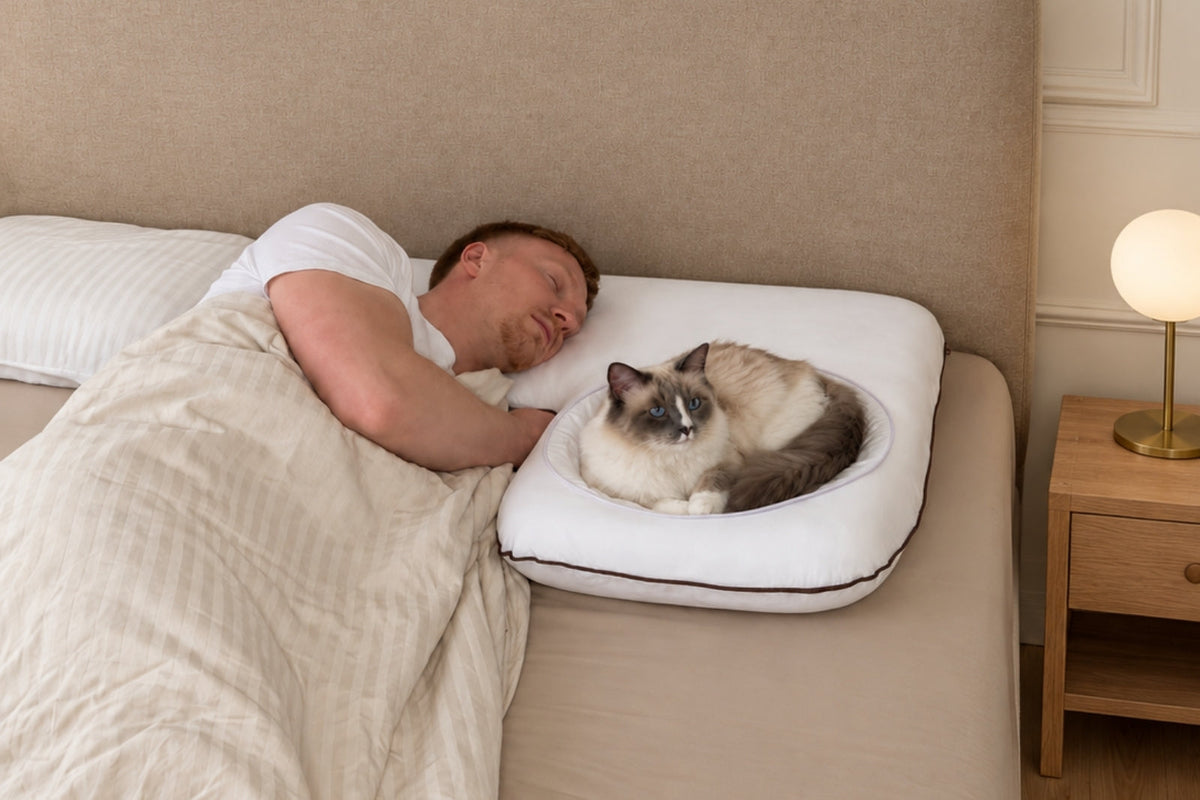
That is why some cat owners end up looking for products designed around co-sleeping rather than just trying to correct the behavior every night. A more structured pillow setup can help guide where your cat settles while still supporting your head and neck properly.
The Pawenza Solace Pillow is one example of that idea. It is meant to give your cat a natural nearby place to rest, while still leaving you with an actual pillow to sleep on. It is not the only possible solution, but it is the kind of setup that makes sense if the issue is closeness without structure.
FAQ: Sleeping With Your Cat
Is it safe to sleep with your cat every night?
For most healthy adults, yes. If your cat is healthy, mostly indoors, and you keep up with normal hygiene, the risk is generally low.
Can sleeping with my cat make me sick?
For most people, the risk is low. The main exceptions are usually allergies, weakened immune systems, or cats with poor hygiene or lots of outdoor exposure.
Why does my cat sleep near my face?
Because that area is warm, steady, and smells the most like you. To your cat, it is one of the most comfortable places in the bed.
Should I stop my cat from sleeping with me?
Not necessarily. In most cases, improving the setup works better than trying to stop the behavior altogether.
How can I sleep better with my cat?
Usually by keeping the bed clean, avoiding face-level sleeping, and giving your cat a clear place to settle that is close to you but not directly on your pillow.
Final Thoughts
For most people, sleeping with a cat is safe.
It can also be one of the nicest parts of having one. The routine, the warmth, the quiet company at night. That part is real.
The bigger issue, most of the time, is sleep quality. Not danger. Just whether the arrangement is actually working for both of you.
So if you love sleeping near your cat, there is no reason to feel strange about it. And if it is not working, that does not necessarily mean you need to stop. It usually means the setup needs to be a little smarter.
You can sleep close to your cat and still sleep well. For most people, that is the balance worth aiming for.